Boat Ramps Nearby
How to load a boat on a trailer
To load a boat on a trailer, drop your crew at the dock, back the trailer in about as deep as you did at launch, guide the boat onto the bunks or rollers, hook the winch strap to the bow eye and crank it up the last few feet. Pull out, move to the staging area and do the rest there. State agencies ask you to use the winch rather than driving the boat on under power, because power loading slowly destroys the end of the ramp.
1. Get the trailer ready
Tie the boat at the courtesy dock or have it idle in open water away from the lane. One person walks up and gets the vehicle. Back the trailer down until the rear of the bunks or the last rollers are under water and the front part is still dry. That way the boat floats onto the trailer and settles in the middle as you winch it up.
Set the parking brake, just as you did at launch.
2. Guide the boat on
Approach slowly and straight. Wind and current push the boat sideways, so steer into them a little. The usual method is to idle the bow up to the rear of the trailer, shut off or tilt the motor, then hook the winch strap to the bow eye and crank the boat forward until it sits snug against the bow stop.
The Oregon State Marine Board suggests another clean option: step onto the boarding dock and walk the boat onto the trailer by the bow line. For wakeboard boats that have no winch, they recommend a short bump of throttle to settle the boat, then neutral, not a long push.
Lines that make loading easier
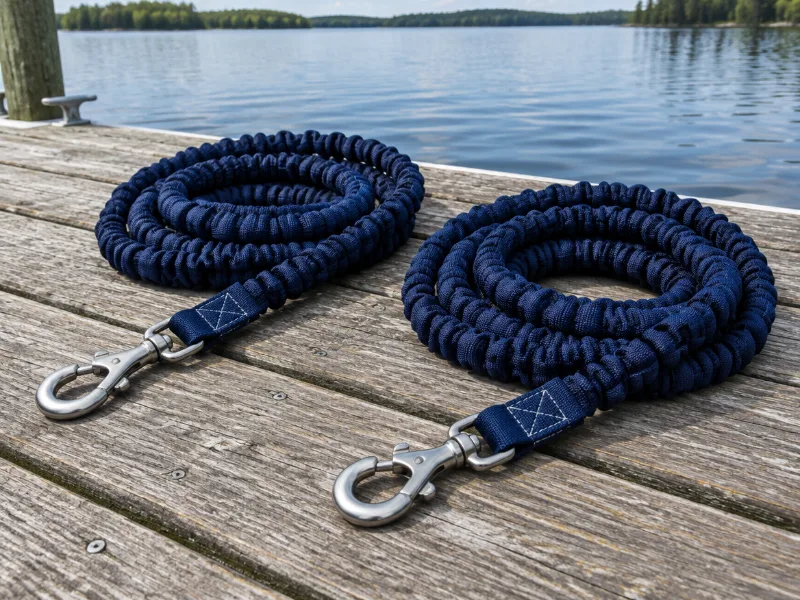
We haven't tested these ourselves; we chose them by size and specs. As an Amazon Associate we earn from qualifying purchases, at no extra cost to you. Check the current price on Amazon.
Why you should not power load
Power loading means driving the boat all the way up onto the trailer with the engine. It is quick, and many boaters do it, but the agencies that build and repair ramps agree it causes real damage:
- The prop wash blasts out a hole at the end of the concrete, the so-called toe of the ramp.
- The sand and gravel pile up into a mound a little farther out.
- Trailer wheels can drop into the hole. Sometimes a vehicle has to be towed out.
- Boats and lower units can hit the mound, especially at low water.
- In bad cases the end of the ramp breaks off and the launch has to close for repairs.
Minnesota and Michigan advise using the winch and keeping the engine just above idle if you use it at all. Oregon calls power loading a discouraged practice and notes that ramp repairs are paid from boater registration fees. A few places go further: the City of Lakewood, Washington, bans power loading at its launches in the municipal code, and news reports from Green Lake County, Wisconsin, describe a county ordinance with a fine. Look for signs at the ramp.
3. Secure everything in the staging area
Pull the rig out of the water and straight into the staging area. Then go through the list:
- Winch strap tight and the safety chain on the bow eye.
- Transom straps on.
- Motor tilted up and locked in the trailering position.
- Drain plug out, livewell and bilge drained. Several states require this before you drive off, see ramp etiquette and invasive species.
- Plants and mud removed from the boat, trailer and motor.
- Loose items stowed or tied down.
- Safety chains crossed under the tongue, trailer lights plugged in and checked.
Before you hit the road
-
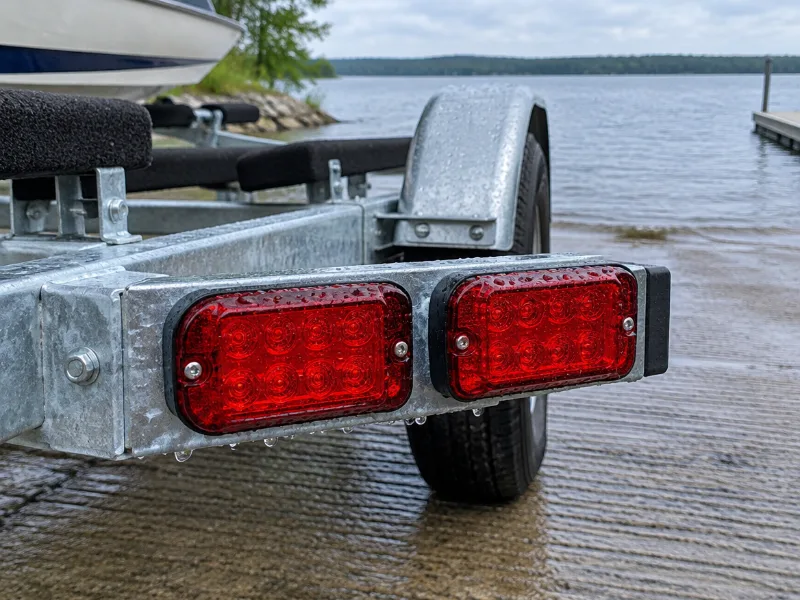 Illustration Partsam 12V submersible LED trailer lights Bulb lights die after a few dunks at the ramp. Sealed LEDs survive backing into the water. View on Amazon
 -
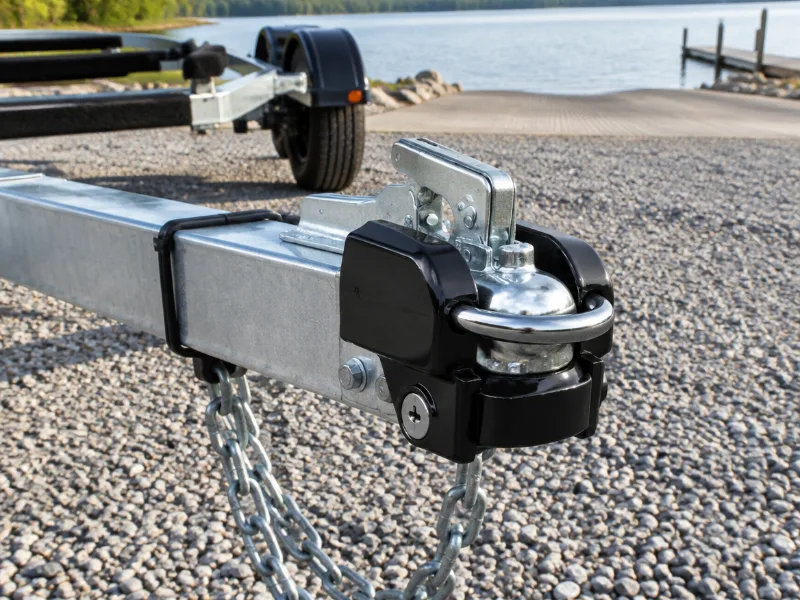 Illustration Master Lock trailer coupler lock (fits 1-7/8", 2", 2-5/16") Your trailer sits alone in the ramp lot all day. A coupler lock keeps it where you left it. View on Amazon
 -
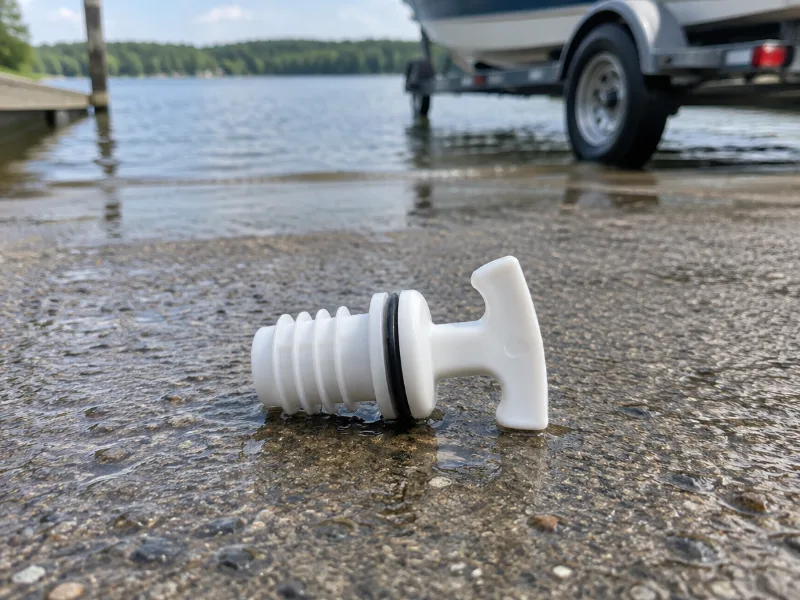 Illustration Bestseller Attwood 7524A7 snap-handle drain plug The forgotten drain plug is the classic ramp mistake. A spare in the glove box saves the day. View on Amazon
We haven't tested these ourselves; we chose them by size and specs. As an Amazon Associate we earn from qualifying purchases, at no extra cost to you. Check the current price on Amazon.